Part 2: SQL Compiler and Virtual Machine
Architecture Overview
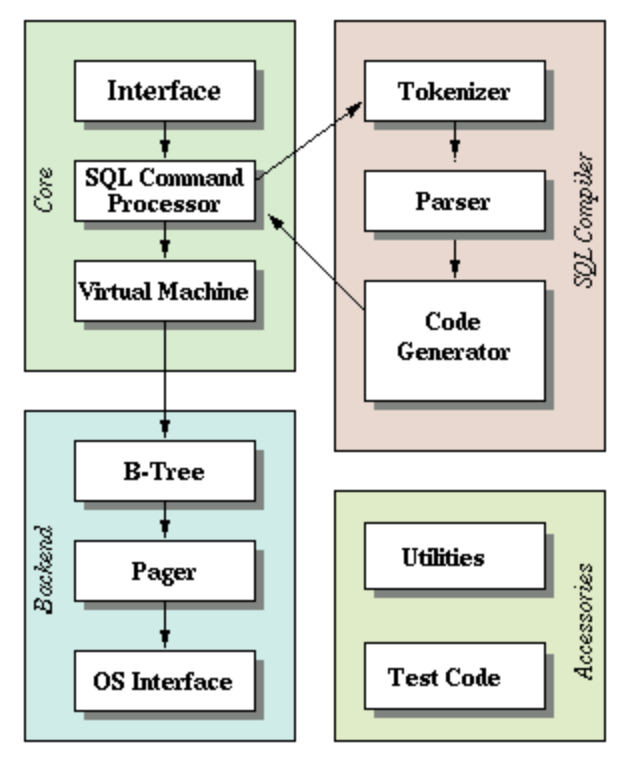
To keep the system modular and easy to reason about, the query execution pipeline is split into two distinct steps:
- Front-end (SQL Compiler): Parses the raw string input and translates it into an internal representation called bytecode (represented as a
Statementstructure). - Back-end (Virtual Machine): Receives the prepared statement/bytecode and executes it against the storage engine.
Advantages of This Split
- Complexity Reduction: The Virtual Machine does not need to worry about syntax errors or string parsing; it only executes validated, structured statements.
- Query Caching: Common or repeated queries can be compiled once and cached in bytecode form to improve execution performance.
Refactoring the REPL Loop
The REPL loop in main is updated to process two types of inputs before execution: Meta-Commands and SQL Statements.
int main(int argc, char* argv[]) {
  InputBuffer* input_buffer = new_input_buffer();
  while (true) {
    print_prompt();
    read_input(input_buffer);

    // 1. Meta-commands (start with '.')
    if (input_buffer->buffer[0] == '.') {
      switch (do_meta_command(input_buffer)) {
        case (META_COMMAND_SUCCESS):
          continue;
        case (META_COMMAND_UNRECOGNIZED_COMMAND):
          printf("Unrecognized command '%s'\n", input_buffer->buffer);
          continue;
      }
    }

    // 2. SQL Compiler / Statement Preparation
    Statement statement;
    switch (prepare_statement(input_buffer, &statement)) {
      case (PREPARE_SUCCESS):
        break;
      case (PREPARE_UNRECOGNIZED_STATEMENT):
        printf("Unrecognized keyword at start of '%s'.\n",
               input_buffer->buffer);
        continue;
    }

    // 3. Virtual Machine Execution
    execute_statement(&statement);
    printf("Executed.\n");
  }
}
Result codes vs. Exceptions
Since C does not support exceptions, we use custom enum result codes (MetaCommandResult and PrepareResult) to indicate success or failure.
typedef enum {
  META_COMMAND_SUCCESS,
  META_COMMAND_UNRECOGNIZED_COMMAND
} MetaCommandResult;

typedef enum {
  PREPARE_SUCCESS,
  PREPARE_UNRECOGNIZED_STATEMENT
} PrepareResult;
Note
Using enums ensures safety during compilation; if a
switchstatement omits a member of the enum, the compiler will throw a warning, forcing us to handle every possible outcome explicitly.
Component details
Meta-Command Processor (do_meta_command)
Non-SQL commands (like .exit) start with a dot (.). These are handled in a separate pipeline stage from standard SQL queries.
MetaCommandResult do_meta_command(InputBuffer* input_buffer) {
  if (strcmp(input_buffer->buffer, ".exit") == 0) {
    close_input_buffer(input_buffer);
    exit(EXIT_SUCCESS);
  } else {
    return META_COMMAND_UNRECOGNIZED_COMMAND;
  }
}
Statement and SQL compiler (prepare_statement)
The Statement structure acts as our bytecode/internal representation. Currently, it supports two basic statement types: STATEMENT_INSERT and STATEMENT_SELECT.
typedef enum { STATEMENT_INSERT, STATEMENT_SELECT } StatementType;

typedef struct {
  StatementType type;
} Statement;

PrepareResult prepare_statement(InputBuffer* input_buffer,
                                Statement* statement) {
  if (strncmp(input_buffer->buffer, "insert", 6) == 0) {
    statement->type = STATEMENT_INSERT;
    return PREPARE_SUCCESS;
  }
  if (strcmp(input_buffer->buffer, "select") == 0) {
    statement->type = STATEMENT_SELECT;
    return PREPARE_SUCCESS;
  }

  return PREPARE_UNRECOGNIZED_STATEMENT;
}
Note that:
strncmpforinser: We usestrncmpwith a length of 6 for"insert"because the keyword will be followed by values/arguments (e.g.,insert 1 cstack foo@bar.com).strcmpforselect: We usestrcmpfor"select"as it is currently evaluated as a standalone keyword.
Virtual Machine Execution (execute_statement)
The initial implementation of out Virtual Machine uses a switch statement over statement->type to execute stubs for supported queries.
void execute_statement(Statement* statement) {
  switch (statement->type) {
    case (STATEMENT_INSERT):
      printf("This is where we would do an insert.\n");
      break;
    case (STATEMENT_SELECT):
      printf("This is where we would do a select.\n");
      break;
  }
}