Chapter 2: Representation of information
Key Concepts
Machine-level instructions
Format of instructions
- A computer program is a sequence of instructions
- At the machine-level, each instruction is represented by a bit pattern
- The number of instructions in a program is finite
- It consists of an opcode and some additional information, such as where operands come form and where to store the results
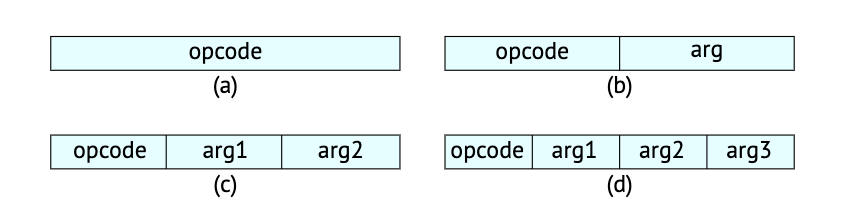
- IA32 example of machine-level instructions
- On some machines, all instructions have the same length; on others there may be many different lengths.
- The opcode for each instructions type must be associated with a unique bit pattern, to identify univocally.
- The instructions of MIPS processors all have 32 bits
- They are classified according to five different types (R, I, J, FR, FI).
- The R instructions have all the data values in registers
- The syntax is:
OP rd, rs, rt. Where OP is the mnemonic for the particulas instructions, rs and rt are the source registers, and rd is the destination register - The machine code for an R instruction has the following format

- An example of an R instruction is:
add $t1, $t2, $t3. Where t2, t2 and t1. 
- The instructions represented by bit pattern
- The syntax is:
Images
Raster images
- A digital image can be represented by a grid os small points.
- A raster image (bitmap image) it is seen as an array of points.
- Each point is represented by a pixel (picture element) and is represented by a binary pattern.
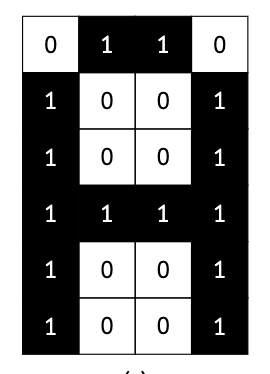
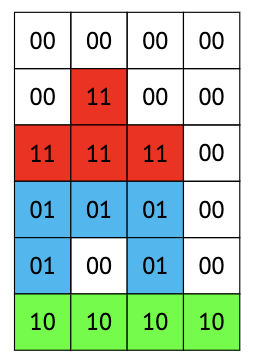
- To draw the picture, a grid must be defined and the squares coloured accordingly.
Image resolution
- The image resolution is related to how close the pixels are.
- It is usually measured in dots per inch (dpi), that is, the number of dots/pixels that can be placed in a line within the span of 1 inch (2.54 cm).
Audio
- To process sound, computers need to convert it into a digital format.
- Sound is recorded using a microphone that translates sound waves into an electrical signal.
- Firstly, sound is recorded using a device, like a microphone, that translates sound waves into an electrical signal
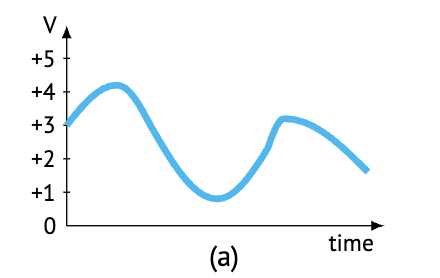
- Then, periodic measurements of the level of that signal are registered.
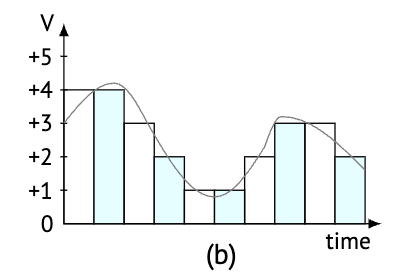
- Sampling is the process that reduces a continuous-time signal to a discrete-time signal.
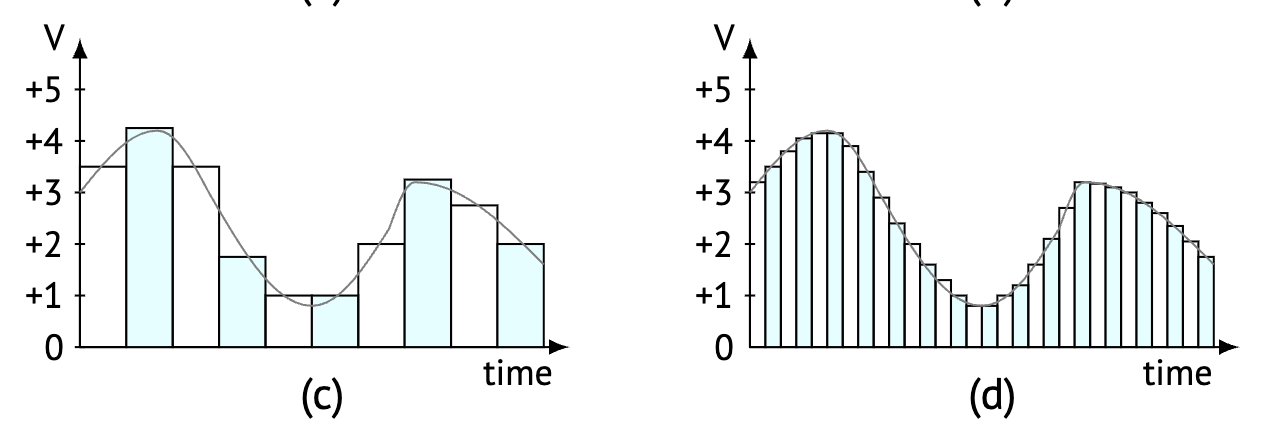
- Sample is the value (or set of values) at a point in time.
- The sample resolution is the number of bits used to represent the value of each sample.
- The sampling rate is the number of samples taken per second, measured in Hertz (Hz). The higher the sampling rate, the better the quality of the audio digital signal, because, if there are more samples, the original sound can be represented more accurately.
- The samples are then simply converted into binary, using a unique binary code.
- Afterwards, the digital sound can be processed by a computer as a sequence of bits.
- Firstly, sound is recorded using a device, like a microphone, that translates sound waves into an electrical signal
Before you go #4
Um caracol está no fundo de um poço com 10 metros de profundidade, Durante o dia, ele sobe 3 metros, mas à noite, enquanto dorme, escorrega 2 metros. Quantos dias levará o caracol a sair do poço?
7 dias e um bocado…?