sc lecture 8
Key Concepts
One’s-complement
- Complement numeral systems were created to make additions faster and easier.
- One decimal number can be subtracted from another by adding the difference of the subtrahend from all nines and adding back a carry. This is called taking the nine’s-complement of the subtrahend, or more precisely, finding the diminished radix complement of the subtrahend.
- The one’s-complements of binary numbers are computed the same way as for natural numbers, except that the weight of the MSB is instead of .
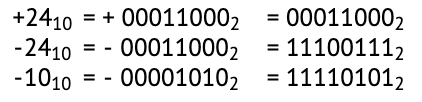
- For a binary number, its one’s-complement is obtained by subtracting from all ones. For example, the one’s-complement of is .
- Complement notation provides a method to represent negative numbers. The idea is that a negative number needs to be converted to its complement, which should have a ‘1’ in the MSB. Positive numbers, which have a ‘0’ in the MSB are used as is, i.e., they are not converted to their complements.
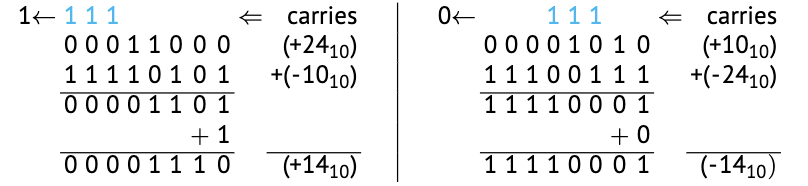
- To subtract from , one needs first to express the subtrahend in one’s-complement and then add it to the minuend . This effectively adds to . The MSB will have a '' or a '' carry, which needs to be added to the LSB of the sum. This operation is designated end carry-around and results from the use of the diminished radix complement, in this case the one’s-complement.
Two’s-complement
- Given a numeric value in base having digits, the radix complement of is defined to be for . With three decimal digits, the ten’s-complement of 43 is 957 .
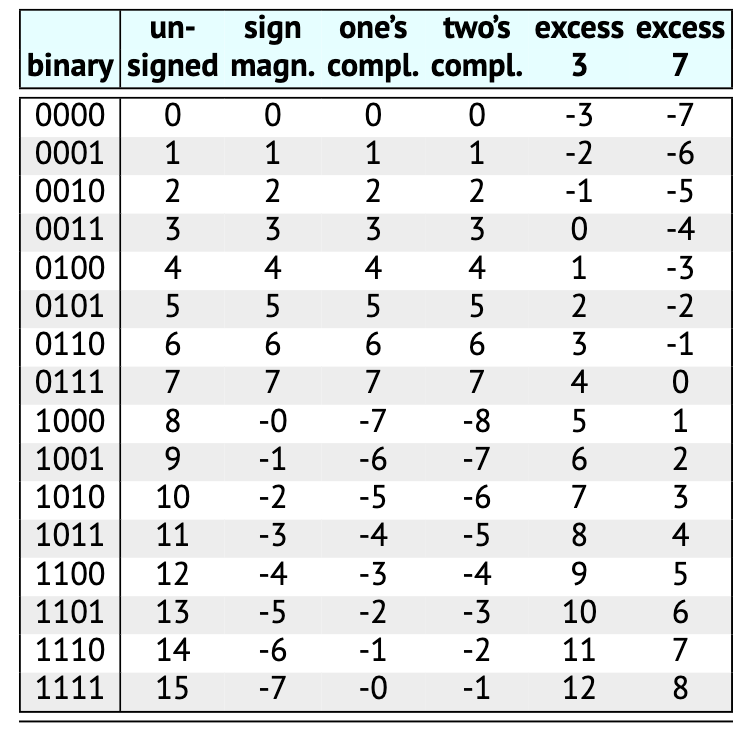
- The decimal value for a two’s-complement number is computed the same way as for a natural number, except that the weight of the MSB is instead of .
- Two’s-complement number are added and subtracted by the same methods as unsigned numbers with the same number of bits, so the same hardware can handle numbers in both
- Its biggest drawback is the assymmetry in the range of values that can be represented.
Excess representations
- In a excess-b representation, an n-bit pattern, whose unsigned integer value is represents the signed integer , where b is the bias (or offset) of the natural system.
- The representable numeric values range from from to .
- The main advantage lies in the fact that the all-zero pattern corresponds to the minimal negative value and the all-one pattern to the maximal positive value.
- It also permits to represent unbalanced sets of consecutuve negative and positive numbers (e.g., from -10 to +245)
- From a mathematical point of view, the representation of natural numbers is an excess-0 representation.
Before yo go #5
Quais são as melhores afirmações erradas que consegues verbalizar para as matérias abordadas hoje?